






The daily news doesn't mention Congo. However the drama of a people in distress is going on. A friend of mine, Father Lucien Favre, a missionary has willingly given to me a strongly committed testimony. See explanations given by Joaquim Mbanza and the interview published in issue 785, May-June 1999 of 'Pentecost around the world",
http://www.spiritains.org/psm.
Thanks to both.
NO MORE PROFITABLE CONTRACTS AT THE EXPENSE OF THE PEOPLE SAKE: INTERVIEW OF F. LUCIEN FAVRE
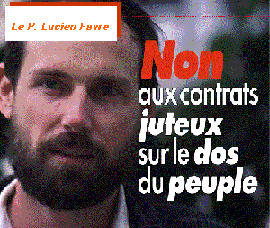
In Congo since 1992, Father Lucien Favre, a Spiritain from Switzerland, 37 years old, has faded away from Dolisie at the end of January 1999. During three days in the forest with two other Spiritains and thousands of Congolese's they fled the combats between the Angola troops following Sassou Nguesso and the "Cocoye" following Lissouba.
Can you explain?
DID YOU FLEE THE SLAUGHTERING WITH THOUSANDS OF CONGOLESE?
We walked in the forest with the people, carrying with us almost nothing, making all of us depend on each other. When on the second day, we heard at the radio, Radio France International (RFI), that a few Europeans had disappeared, we felt very much revolted . RFI was wondering if we would have been taken as hostages by the rebels when we were among these thousands of abandoned and pursued people. Our revolt was coming from this confirmed fact that dramatic African problems were only worth mentioning when some whites are involved.
When a policeman is killed in front of the French Embassy, it is a scoop. If at the same time 1 500 civilians from Congo lost their life after bombing of the south quarters of Brazzaville, nobody speaks about it.
ARE WESTERN COUNTRIES REALLY INTERESTED IN AFRICA?
Western countries are interested in Africa which has become today an hostage of liberal economy. An example: the very rich soil of Dolisie can produce vegetables and maize all year around. Chicken breeding can be undertaken without difficulties. Unfortunately we are victimized by the overproduction of the European Community. Loads of frozen chickens are put on the markets at low price, impossible to compete with. A frozen chicken is 500 CFA worth. To raise a chicken at Dolisie, it should be sold at 1 500 CFA to leave a little benefit to the local producer. Then Africa becomes the dustbin of our economy. Every thing is organized for Africa to consume all that will be otherwise discarded in western countries. Skillful companies make profit in Africa by emptying the freezers of the Europeans markets.
Today in war regions, the World Program for Food (PAM) overthrow the local economy by distributing tons of maize. During the 1997 war, the Director of the PAM did not understand that I refused on behalf of the Catholic Relief a gift of 2000 tons of maize in saying: "let the women sell their maize".
They are many such poisoned gifts. See all these clothes which are picked up for the poor over there and which are sold to them at low price. It is just enough to upset the economy of the countries producing cotton. As a member of the Peace Corps in Madagascar, I saw people preferring to buy used jeans rather than to buy a shirt made in the country because they are attracted by what is coming from Western countries. Some times these kind of gifts eliminate entire families of producers.
It is not politics but in reality political economy. Big international companies from the West have great interest in exploiting natural resources from poor countries. What is less known is that our countries export their own problems. Our farmers who are overproducing at the cost of a flood of chemicals not very environmentally safe, demonstrate in Brussels and in Paris or by throwing cabbages on the highways. Nobody knows how to make them produce less. The solution? Sell to young countries where the market is profitable, where population are growing and where the needs are enormous. It becomes a necessity that these countries do not produce by themselves what they need, on the contrary they have to consume as much as they can in order that wealthy countries get as much a profit as possible.
WHERE IS COOPARATION, SOLIDARITY BETWEEN FRENCH SPEAKING COUNTRIES?
Talking about French speaking communities is a joke. This badly hides an economic interest. It is easier for French companies to install themselves in French speaking countries and to obtain profitable contracts when your partners speak the same language. It is at that level that politics intervene. One look for a President who is favorable for the French interest (see the French politics in Togo, Cameroon, Gabon and Congo-Brazzaville).
DO THE FRENCH COMPANIES INFLUENCE POLITICS IN CONGO?
Elf-Aquitaine has the most impact on the politics of this country. As oil is extracted off-shore: the country can collapse without Elf losing a drop of this liquid gold. The company bloats of it. Many Lebanese's, born as traders, are influential, so are the Forest Companies.
DO THESE COMPANIES OR TRADE COMPANIES SELL ARMS TO THE REBELS, THE MILITARY FORCES?
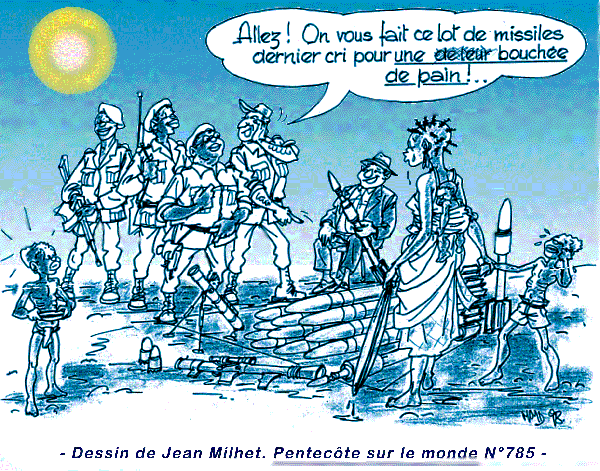
More than the Countries, the transnational big Companies are influential. For instance 40 % of Elf asset are from USA. No direct responsibilities are involved, however FIBA, the Elf Bank, directly pays the salaries of the military forces. Through the Company, the Congolese government receives the necessary money to buy arms. In 1997, FIBA was financing the two sides: soldiers of the government and Lissouba's rebels. They could have given more help to the rebels.
When people are killing each other, this makes it easier for a foreign company to control the situation. This happens in Congo as somewhere else. A whole population becomes an hostage of selfish interest. This population pays the higher price: fanaticism and fraternal struggles. Politicians fight against each others, North against South, the people are lost, afraid, exterminated, they don't understand what is at stake.
Local politicians fight for their own benefit. The winner knows that Elf will enrich his bank account in Switzerland or elsewhere with a good percentage of the revenue which should belong to the people. One looks at the corrupted leaders but not on those who corrupted them. When the people will start to be aware of this, it will be more difficult to ignore them. People look for common good. They refuse the leaders who misuse them, who use the ethnic reason for making war. They do not accept that the leaders use religion and sit in the first row at church.
WHO CAN DO SOMETHING FOR CONGO?
One should not forget about the suffering and dying people who are not reported in the press. These people without a voice who has to flee in the forest. They do not give up. They meditate the Gospel. The Church can be their voice but it has to take its distances from the governments, to stop to work with them. Prayer is important but that should not reduce the action and the engagement of the church. A prayer which sheds a light, which helps the people to take responsibilities. Perhaps it is like that that things will change.
One should not cry upon a lost Africa, populated with poor people. We should understand that our economic security should not be built in part on the suffering of others."
An explanation:
CRIMES AGAINST HUMANITY
 One has to recall that there has been a
civil war in Congo in 1993. The one in 1997 is the second one since restoration
of democracy in 1991 after a National Conference chaired by Mgr. Ernest
Kombo.
One has to recall that there has been a
civil war in Congo in 1993. The one in 1997 is the second one since restoration
of democracy in 1991 after a National Conference chaired by Mgr. Ernest
Kombo.
This second civil war has been the most terrible: the two parties bombed the most popular quarters of the city, leaving 10 000 dead and massive destruction in Brazzaville. General Denis Sassou Nguesso defeated the ex-Head of State Pascal Lissouba, who started the civil war and he went in exile with his Prime minister Bernard Kolelas. His followers could not leave Congo and take refuge in remote villages and even in the forest. Their groups in fact kept their arms. When Sassou Nguesso got into power, after his victory on Lissouba, a National Forum of reconciliation between political forces which stayed in Congo and the civil society was organized in January 1998 in Brazzaville. The party in power, by calling the former dignitaries as "genocide agents" and accusing them of crimes against humanity, upset the partisans of M. Lissouba and mostly those of M. Kolelas. Since August 1998, a series of incidents happened in Pool region between the public forces, former militias of the present Head of State and the ex-ninjas, militias of M. Kolelas.
The situation is aggravated by the assassination by the ex-ninjas, of
local dignitaries in Pool region accused of collaborating with the present
government. The government sent troops in this region who brought more disorders:
pillages, rapes and killings. The diocese of Kinkala which covers approximately
the Pool region at the South of Brazzaville is properly pillage.
Joachim Mbanza, chief editor of La semaine africaine (African Week), a weekly catholic magazine.